Trump Signaled Openness to 7-OH. Weeks Later, DEA Moved to Schedule It as Schedule I.
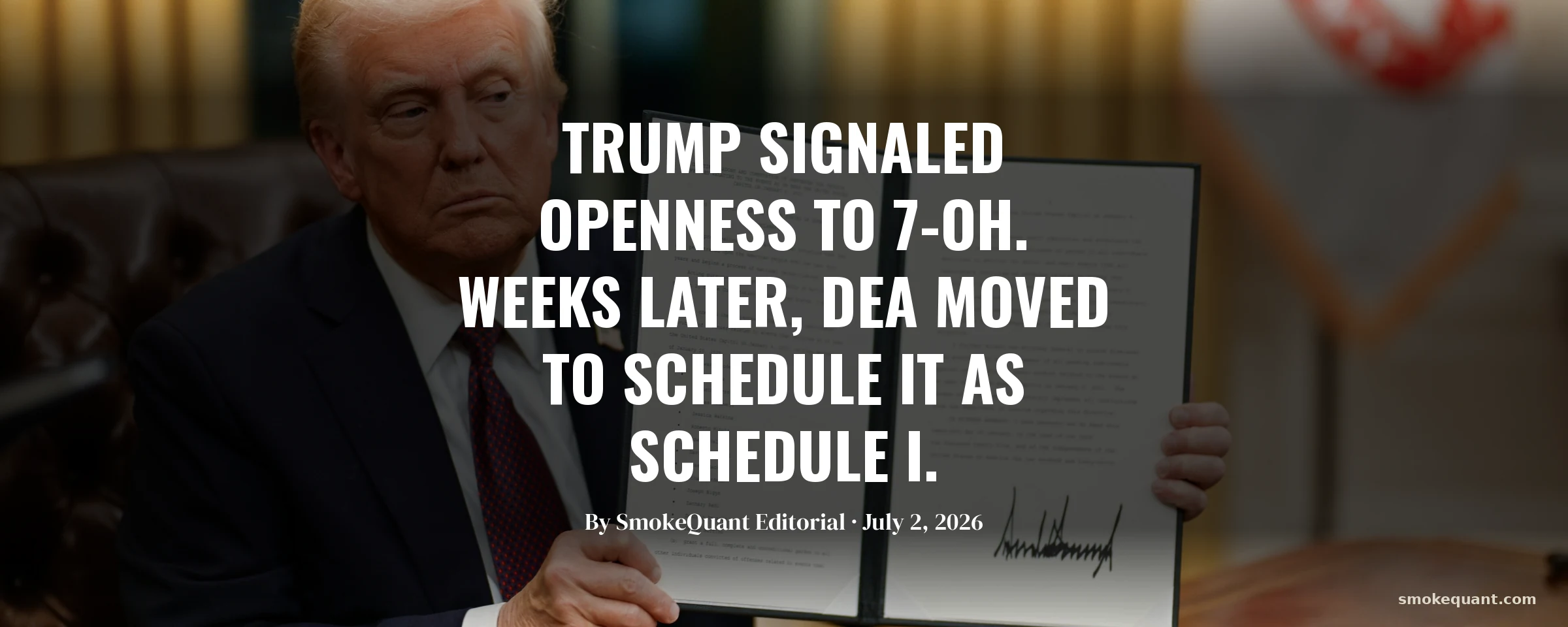
Photo: The Trump White House / Wikimedia Commons (Public Domain)
President Trump said in May he was looking at approving natural 7-OH. Weeks later, the Drug Enforcement Administration has moved to place 7-OH into Schedule I nationwide, the same category as heroin and LSD, through a temporary order expected to take effect in early August. The action targets concentrated and processed 7-OH above a set threshold, while leaving natural kratom leaf below that threshold untouched.
On May 11, President Trump told reporters in the Oval Office that he was looking very seriously at natural 7-OH and getting it approved. Weeks later, the DEA used its temporary scheduling authority under the Controlled Substances Act, which lets the agency place a substance in Schedule I for up to two years without a hearing, provided the Department of Health and Human Services does not object. HHS did not object. Instead, HHS and the FDA commended the action, and HHS opened a public docket seeking comment on the threshold level through July 31.
The threshold is the core of the action. It reaches natural kratom material only when it exceeds 0.050 percent 7-OH by dry weight, and separately reaches synthetic 7-OH and processed forms such as extracts, concentrates, edibles, and pressed pills above that level or above 1.00 milligram per article. DEA Administrator Terrance Cole said the action targets highly concentrated, synthetic 7-OH products, and the agency said its lab testing shows commercial products often contain far more 7-OH than natural leaf.
The agency said the finding rests on data showing 7-OH acts on the body like an opioid, with risks of tolerance, dependence, and respiratory depression. The DEA cited earlier FDA warning letters to seven companies in July 2025 and a December 2025 seizure of about 1 million dollars in 7-OH products from three Missouri firms.
The action makes concentrated 7-OH a Schedule I controlled substance nationwide once the temporary order takes effect, expected in early August, reaching the tablets, gummies, shots, drink mixes, dissolvable strips, and extracts sold in smoke shops, convenience stores, gas stations, and online. Products over the threshold, whether synthetic or processed from kratom, fall under the same federal criminal, civil, and administrative penalties as heroin. Natural botanical kratom that stays below 0.050 percent 7-OH by dry weight is not covered by the order. Nine states already ban 7-OH outright and four cap its concentration, and the federal action layers on top of those state rules.
Because this is a temporary scheduling order, it lasts up to two years while permanent scheduling is considered, and HHS is taking comment on the threshold through July 31.